
Life as an Unfolding Journey
If you were to reflect back on your adult life, you’d likely notice how many changes and transitions have already shaped you. Our culture and worldview strongly influence how we relate to the timeline of our lives. We’re taught to optimize, fix, and problem-solve our way forward. But I’d like to invite us to view our lives as an unfolding journey. A life with overlapping themes, chapters, and threads. What if our lives are not problems to solve, projects to complete, or something to figure out once and for all, but something that slowly reveals itself over time? When we allow life to unfold, we become more receptive to timing, to invitations, and to the deeper currents at work beneath the surface.
Adulthood as a Developmental Process
We easily recognize developmental stages in childhood, but in adulthood, we often assume that kind of growth is over, that we should know by now, or have arrived already. “Should” is a sure sign of our inner critic shaping our expectations. And approaching transition from this perspective can limit our sense of what’s possible. Adulthood is also rich with development, and when we attune to life in this way, meaning, purpose, and clarity tend to emerge over time, not all at once.
“The first half of life is about building the container; the second half of life is about filling it.” — Richard Rohr
The Arc of Becoming
It’s been helpful for me to remember the longevity of our lives, if we are fortunate enough to have that. Intentions and new chapters often unfold slowly, across years rather than moments. I tend to view life in larger stages, with smaller phases nested within them. Things take the time they take to gestate. When we honor this longer arc, there’s often more patience, compassion, and less urgency to force an answer before it’s ready.
The In-Between: Feeling Stuck
Along the way, we’re likely to get stuck. Feeling stuck can be a sign that something is reorganizing internally. Something is ending, or coming to an end, and something new has not yet fully arrived. We find ourselves in an in-between space. In these moments, doubt can surface: Maybe I don’t have what it takes. Or we may feel pulled in different directions, as if many parts of us hold competing needs or concerns.
Very often, we’re so focused on what’s coming next, we overlook what’s being left behind. But every new chapter sees an ending; an identity, a role, a way of being in the world that no longer fits. Even welcome changes come with sadness or grief. When we take the time to recognize what’s been meaningful or lost, something softens. We let go more fully, and we create room for what’s emerging.
“What we call the beginning is often the end. And to make an end is to make a beginning. The end is where we start from”. - T.S. Eliot, “Little Gidding”
Meeting the Critic with Care
Anytime we step into something new, it’s so common to meet our inner critic. It often emerges when we’re in new territory. It’s helpful to appreciate its good intentions; trying to protect us from risk, mistakes, or stepping too far beyond the known. The inner critic is just one part of us, not the whole. When we pause, ask questions, and acknowledge its efforts, old patterns can soften and new perspectives can open.
When the critic or our other parts are activated, we can forget our wholeness. In this work, we remember it together. We listen for and care for our parts without confusing them with who we are. You are not your parts. We remember ourselves as Presence. Feeling grounded, confident, and able to take the lead in your own life. The journey is filling the container of our lives and acting from these many qualities of Presence.
Discomfort as a Threshold
One of the most helpful capacities in this stage of the process is being with not knowing. As the protagonist—or initiate—of your own journey, you will encounter uncertainty, success, failure, and moments of real discomfort. Over time, you may begin to trust that discomfort is not something to avoid, but something to listen to. It often marks the edge of growth. The place where something is loosening and something new is forming. In this context, discomfort is not a problem. It’s a sign that something new is unfolding.
A Collective Transition
Many of us also sense that we’re living through a collective transition. We’re living through a global ordeal, and ordeals have a way of shaking our confidence, asking us whether we truly have what it takes. I’m here to suggest we do. This is a practice of remembering as well as a process of becoming. We’re remembering our innate capacities, the creativity, the strength, and the trust required for this moment. In his new book, “In the Absence of the Ordinary”, Francis Weller reminds us that in this collective unknown, we’re called into the practice of deep listening, which acknowledges the wisdom we carry, the wisdom of others, and the wisdom we discover when we listen to the dreaming Earth. When we listen deeply, we begin to discover what wants to come forward. He calls listening the art of reverence.
Loss and gain dance together. In each moment, we lose and simultaneously gain; one moment dies to birth the next. Just as the death of a cloud signifies the birth of rainfall, or the breaking of a seed signifies the beginning of the tree, the old births the new. - Georgi Y. Johnson
The Wisdom of Dreams and Nature
I offer many ways to support unfolding transitions. The foundation of my approach is Parts Work, which is an elegant and efficient way to understand ourselves more deeply. And one of my favorite supporting practices is dreamwork. Think of our dreams as just-in-time support; gifts freely given each night. We don’t have to do anything special to receive them. When we take the time to write them down and listen to them, dreams often show us what’s getting in the way and point us back to our wholeness and inherent capacities.
Nature has also been a supportive partner in my life. Turning to nature helps us see wholeness and offers us metaphors that mirror our own unfolding. You may have noticed I use a lot of butterfly images throughout my website. The photographs of my own life are full of butterflies. The butterfly as a symbol of transformation may be well-used, but I find it meaningful, beautiful, and helpful.
The disorientation and discomfort we feel in transitions is a kind of cocooning. The caterpillar enters a kind of dissolution. A messy middle where familiar structures break down into something unrecognizable. Inside the chrysalis, the caterpillar dissolves. Its familiar structure breaks down into what looks like undifferentiated goop. Nothing about this stage suggests clarity, progress, or success. And yet, within that dissolution, something remarkable is happening.
Within the caterpillar are imaginal cells—cells that carry the blueprint of the butterfly. The old cells don’t recognize them and may even attack them. But the imaginal cells persist. They find one another, cluster, and slowly begin to organize. Eventually, they become the guiding intelligence of the transformation. From what looks like a breakdown, a butterfly emerges.
Our own transitions can feel the same. Old identities loosen. We may feel uncertain, tender, or disoriented. This in-between is not a problem to fix, but a necessary phase of transformation. What if, in these moments, we are not failing but transforming? What if the confusion, the grief, the not-knowing are signs that something deeper is reorganizing? Like the imaginal cells, something within us already knows what is trying to emerge, even when the outer form hasn’t yet taken shape.
In this collective moment, I want to suggest we are being asked to live more like imaginal cells—awakening, finding one another, and trusting that small, quiet acts of remembering can participate in a much larger unfolding.
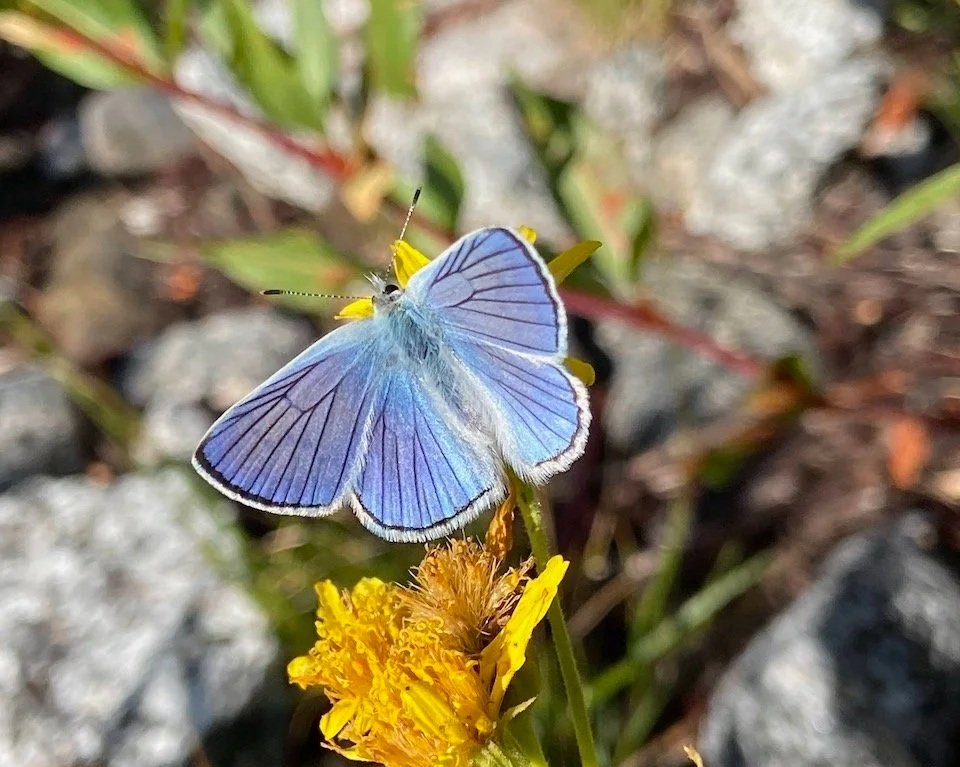
Lycaena heteronea, the blue copper, is an American butterfly that belongs to the gossamer-winged family.
Eagle Cap Wilderness. Photo credit, Brian Gefroh.
Partnering Together
As a coach, I can’t point you toward your life, purpose, or next step. My life has unfolded through its own unique chapters and challenges. But I can walk alongside you when you feel stuck, help you listen more deeply, explore and unfold your dreams, and reconnect with your inner guidance and your resourcefulness.
Life is not asking you to fix or solve it. It’s inviting you to participate. To listen, respond, experiment, and trust the unfolding.
Is This Coaching for You?
You are at a crossroads or feeling stuck.
You recognize you are in the middle of a transition, but aren’t sure what’s next.
You have a longing to step into the next version of yourself.
You want to pursue a dream, goal, or vision and want support in the process.
You want to connect with your inner guidance.
You are looking for new access to creativity and inspiration.
I’d love to hear from you if coaching could help support this discovery. We start exactly where you are and explore the threads together.
Reach out if you’d like to chat.
Learn more about my learning programs.